RI INTERVIEW. Nicola Luise “Il negozio fisico diventa intelligente: il valore della Retail Intelligence”
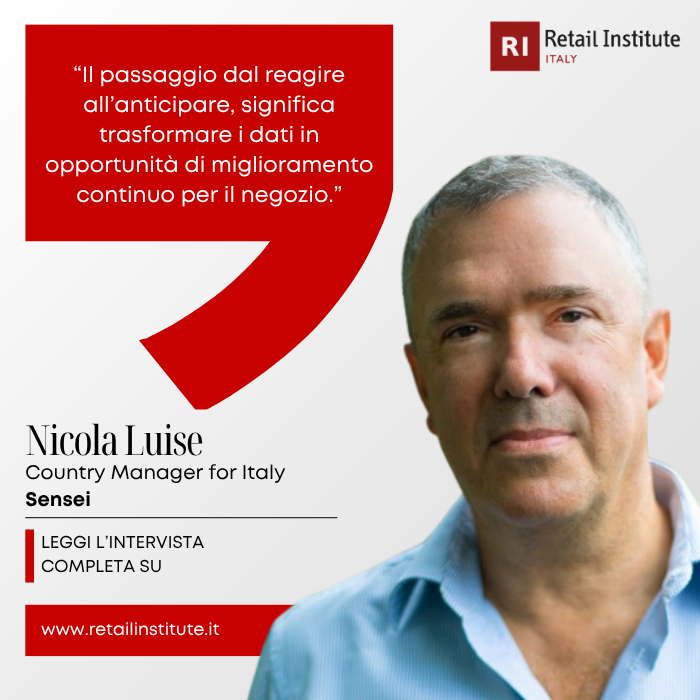
Intervista a Nicola Luise, Country Manager for Italy, Sensei.
Quali sono i principali cambiamenti che stanno trasformando il negozio fisico?
Il Retail fisico sta vivendo un cambiamento strutturale. Per decenni il punto vendita è stato una specie di scatola nera: i retailer non avevano quasi nessuna visibilità su cosa succedesse davvero tra l’ingresso del cliente e il momento del pagamento. Questo sta cambiando, e velocemente.
Ci sono tre fattori dietro questa spinta. Il primo è il costo del lavoro, che continua a salire, insieme alla difficoltà di trovare personale: la conseguenza è che i retailer devono ripensare dove concentrare le persone e dove invece lasciar fare alla tecnologia. Il secondo è che i clienti sono diventati molto meno pazienti: una fila, un prodotto esaurito, un servizio lento oggi fanno perdere una vendita in un modo che dieci anni fa non succedeva. Il terzo è che i dati stanno finalmente entrando in negozio in modo concreto. Chi per anni ha preso decisioni guardando il report di fine giornata si sta rendendo conto che avere l’informazione in tempo reale non è più un vantaggio competitivo: è diventato indispensabile.
I negozi che vinceranno saranno quelli che useranno la tecnologia per valorizzare meglio il personale, non per sostituirlo: meno tempo su attività ripetitive, più tempo su servizio, gestione dei freschi e su tutto ciò che davvero crea fedeltà nel cliente. In Italia, in particolare, il dibattito si sta muovendo rapidamente: i retailer oggi fanno domande molto più stringenti sul ritorno dell’investimento e sull’economia del punto vendita rispetto a solo due anni fa.
Dati e Intelligenza Artificiale hanno un ruolo sempre più centrale nel Retail. Come aiutate i retailer a capire meglio il comportamento dei clienti e a ottimizzare le performance del negozio?
In parole semplici: Sensei è uno strato di intelligenza artificiale applicato al negozio fisico. Le telecamere e i sensori sullo scaffale sono solo il modo in cui il sistema “percepisce” cosa succede in negozio — il vero valore sta in quello che facciamo dopo, cioè trasformare quel segnale grezzo in una lettura continua e strutturata del punto vendita: cosa c’è sullo scaffale, cosa i clienti prendono in mano, dove si fermano, come sta andando il negozio in questo preciso momento, non ricostruito a posteriori. Questa stessa intelligenza è anche alla base del nostro checkout autonomo, perché il sistema sa già cosa il cliente ha preso ancora prima che arrivi all’uscita.
Su questo fronte si muove tutto il settore, quindi non è un terreno dove rivendico un’esclusiva. Quello che fa la differenza è la profondità e l’affidabilità dell’informazione che riusciamo a estrarre, non l’hardware che la raccoglie. I nostri modelli seguono le interazioni con ogni singolo prodotto in tutto il negozio, in modo continuo — non con controlli periodici o dati campionati. Questo genera informazioni prima impossibili da ottenere senza un’osservazione manuale: quante volte un prodotto viene notato, i tassi di conversione, la share of shelf, le heatmap di clienti e scaffali, le performance delle campagne, la composizione del carrello, i tempi di permanenza e i percorsi del personale in
negozio.
L’impatto pratico è concreto. Invece di rifornire lo scaffale seguendo un giro programmato, il personale riceve un avviso nel momento esatto in cui un prodotto ha bisogno di attenzione, con la priorità calcolata sul fatturato a rischio. Invece di leggere il report di vendite del giorno prima, chi gestisce il negozio vede in tempo reale come sta andando in quel momento. Questo passaggio — dal reagire all’anticipare — è ciò che trasforma un negozio da scatola nera a un teatro di continuo miglioramento.
Le tecnologie di automazione e le soluzioni di cassa autonoma stanno ridisegnando l’esperienza d’acquisto. Quali opportunità offrono oggi ai retailer?
L’opportunità più grande non è snellire la permanenza in cassa — è ripensare il modello stesso di negozio. La Retail Intelligence permette ai retailer di estendere gli orari di apertura senza aumentare i costi del personale, di spostare le persone da compiti ripetitivi in cassa verso ruoli a maggior valore, e di gestire formati in location dove un modello di staffing tradizionale non sarebbe economicamente sostenibile.
L’approccio di Sensei è costruito per non richiedere al cliente nessuna app, nessun check-in, nessuna scansione. Il cliente entra, prende ciò che vuole e esce. Il sistema costruisce il carrello in tempo reale, in modo invisibile. Questo elimina la principale barriera all’adozione, e funziona indipendentemente dall’età del cliente o dalla sua familiarità con la tecnologia — un aspetto che conta molto in un mercato come quello italiano, con la sua varietà di profili di consumatori tra regioni e generazioni.
Nei negozi già operativi, oltre il 70% delle transazioni passa attraverso la retail intelligence di Sensei senza cassa presidiata, con riduzioni misurabili del tempo di spesa e guadagni di efficienza del personale rispetto ai formati tradizionali. La soddisfazione del cliente è rimasta stabile o è migliorata — i clienti non notano la tecnologia, notano che l’esperienza è migliore.
C’è un progetto in particolare di cui vorrebbe parlarci?
Due progetti insieme raccontano la direzione in cui sta andando la retail intelligence — e uno di questi si trova proprio qui in Italia.
Il primo è Continente Bom Dia a Leiria, in Portogallo, il supermercato più grande al mondo a utilizzare la Retail Intelligence: 1.200 metri quadrati, oltre 11.000 referenze (SKU), comprese le aree a servizio assistito per panetteria, pescheria e macelleria. Ha dimostrato qualcosa di cui il settore dubitava: che la retail intelligence funziona su scala di grande distribuzione completa, e non solo nei piccoli formati convenience. Oltre il 70% delle transazioni avviene senza passare da una cassa presidiata, e il tempo medio di spesa è ridotto di oltre 22 minuti.
Il secondo — ed è quello che segnalerei direttamente ai colleghi della nostra associazione — è il Conad Tuday Prendi&Vai di Via Stella a Verona: uno store di urban convenience di 215 mq sviluppato con DAO Cooperativa. In Via Stella, DAO e Sensei hanno implementato la piattaforma di Retail Intelligence di Sensei per gestire il negozio end-to-end: il sistema comprende in tempo reale ciò che accade nell’area vendita e compone il carrello di ciascun cliente mentre fa la spesa, senza bisogno di casse presidiate. I clienti entrano, prendono i prodotti ed escono. Il personale è svincolato dalla cassa e può essere reindirizzato all’assistenza e al riassortimento.
I risultati parlano da soli. Il punto vendita di Via Stella ha superato il budget di vendita del primo anno del 60%, registrando un’ulteriore crescita del 25% nel secondo anno. Genera il 35% in più rispetto a un negozio tradizionale comparabile. Raggiungere questi obiettivi ha richiesto un importante lavoro di adattamento del modello alle abitudini d’acquisto italiane, in stretta collaborazione con DAO, anziché applicare meccanicamente un format creato altrove.
English version
What are the key changes currently transforming the physical store environment?
Physical retail is going through a structural shift. For decades, the store operated as a black box: retailers had almost no visibility into what actually happened between the moment a customer walked in and the moment they paid. That is changing, and changing fast.
Three forces are driving it. First, rising labour costs and staffing shortages are pushing retailers to rethink where human effort is best spent. Second, shoppers are simply less patient than they used to be — queues, out-of-stocks, and slow service cost a sale in a way they didn’t a decade ago. Third, data is finally entering the store in a meaningful way. Retailers who spent years making decisions
from end-of-day reports are realising that real-time intelligence isn’t a luxury anymore — it’s table
stakes.
The stores that win will be the ones that use technology to make people more effective, not to replace them. Less time on repetitive tasks, more time on service, freshness, and the things that actually build loyalty. In Italy specifically, this conversation is moving quickly — retailers here are asking harder questions about ROI and store economics than they were even two years ago.
Data and Artificial Intelligence are playing an increasingly central role in retail. How do you help retailers better understand customer behavior and optimize store performance?
In plain terms: Sensei is an intelligence layer for the physical store. Cameras and shelf sensors are simply how it senses what’s happening on the shop floor — the real product is what happens after that: turning raw signal into a continuous, structured understanding of the store. What’s on the shelf, what customers are picking up, where they’re spending time, how the store is performing right now rather than reconstructed after the fact. That same intelligence also underpins our autonomous checkout, since the system already understands what a customer has picked up before they reach the door.
Most of the industry is chasing some version of this, so I won’t pretend the ambition is unique to us. What matters is the depth and reliability of the intelligence itself, not the hardware that feeds it.
Sensei’s models track product-level interactions throughout the store, continuously, not through periodic audits or sampled data. That generates insight that was previously impossible without manual observation: product impressions, conversion rates, share of shelf, customer and shelf heatmaps, campaign performance, basket composition, dwell time, and staff journey analytics.
The practical impact is concrete. Instead of restocking on a scheduled shelf walk, staff get an alert the moment a product needs attention, prioritised by revenue at risk. Instead of reading yesterday’s sales report, a store manager sees a live view of how the store is performing right now. That shift — from reactive to proactive — is what turns a store from a black box into an operation that keeps improving.
Automation technologies and autonomous checkout solutions are reshaping the shopping experience. What opportunities do they offer retailers today?
The bigger opportunity isn’t removing friction at checkout — it’s rethinking the store model itself.
Retail intelligence lets retailers extend service hours without increasing staff costs, redeploy teams from repetitive checkout tasks to higher-value roles, and operate formats in locations where traditional staffing wouldn’t be economically viable.
Sensei’s approach is built around requiring no app, no check-in, and no scanning from the shopper.
The customer walks in, picks what they want, and leaves. The system builds the basket in real time, invisibly. That removes the main barrier to adoption, and it works regardless of a customer’s age or comfort with technology — which matters a great deal in a market like Italy, with its mix of shopper profiles across regions and generations.
Across live deployments, over 70% of transactions run through Sensei’s retail intelligence without a staffed checkout, with measurable reductions in shopping time and gains in staff efficiency versus traditional formats. Customer satisfaction has held steady or improved — shoppers don’t notice the technology, they notice that the experience is better.
Is there a particular project you would like to tell us about?
Two projects together tell the story of where retail intelligence is heading — and one of them is right here in Italy.
The first is Continente Bom Dia in Leiria, Portugal, the world’s largest supermarket running on retail intelligence: 1,200 square metres, over 11,000 SKUs, including assisted-service areas for bakery, fishmonger and butchery. It proved something the industry had doubted — that retail intelligence works at full grocery scale, not only in small convenience formats. Over 70% of transactions run without a staffed checkout, and average shopping time has dropped by more than 22 minutes.
The second, and the one I’d point our association colleagues to directly, is Conad Tuday Prendi&Vai Via Stella in Verona — a 215 sqm urban convenience store developed with DAO Cooperativa. At Via Stella, DAO and Sensei deployed Sensei’s retail intelligence platform to run the store end-to-end: the system understands what’s happening on the shop floor in real time and builds each customer’s basket as they shop, with no staffed checkout required. Shoppers walk in, pick products, and leave.
Staff are freed from checkout and redirected to service and replenishment. The results make the case on their own. Via Stella beat its year-one sales budget by 60%, and grew a further 25% in year two. It generates 35% more than a comparable traditional store. Getting there
took real work adapting the model to Italian shopping habits, in close partnership with DAO, rather than dropping in a template built elsewhere.